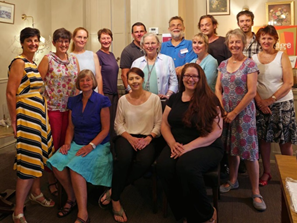
Nikita Parks – Candidate for Division Director

Nikita Parks – Candidate for Division Director

Why are you running for this District Leadership Role? Why now?

Nikita Parks, ACS, ALB

When I joined Toastmasters to recover and develop my confidence and public speaking skills during my divorce, I did not anticipate that I would also develop leadership skills. These are precious and integral to becoming the best person I can be following my extraordinarily challenging life and eventual gender transition. I feel deeply grateful to and passionate about Toastmasters where I have received almost total acceptance in stark contrast to the adversity I experienced at work and from close relatives. That’s why I am determined to serve to the best of my ability.

I am volunteering for Division Director as progression from Area Director and Club President. I wish to keep on stretching and developing my leadership skills by taking on new challenges. I am highly motivated and enthusiastic, so it does not make sense to take a break. I also want my skills and experience in Toastmasters to be relevant to and be trusted by other District Leaders by the time district realignment occurs, to be of service when needed.

What is your vision for the role?

My vision as Division Director is to cultivate a sense of community within my division through delivering valuable activities. Toastmasters has a great deal to offer, yet due to the introspective nature of many clubs, there is a perceived ceiling on personal development which is misconceived. Through fostering inter-club mentoring, I want members to look beyond their clubs by default in future, to embrace all that Toastmasters can offer and to take the initiative to make things happen. Leadership skills come from committed active leading, not from mere attendance.

How will you go about achieving this vision?

To achieve this vision, I need to provide members of clubs with useful and relevant leadership and speaking experiences at club, area, division and district level. It’s not enough to entice a small minority of members to a remote district conference. I have already started at club level by seeking to replicate London’s successful general evaluator and speaker exchange in the west of our district. My vision would need to be shared and articulated by my Area Directors consistently in all their engagements with their clubs and delivered by organising and holding events. Toastmasters needs to think globally but act locally.

How do you plan to achieve Distinguished status?

Besides using tools like Moments of Truth, the Success Plans and Area Director visits, I will achieve distinguished division status through my vision. Cultivating community will improve membership retention because members will recognise that there is tangibly more on offer to them than the regular routine of their club meetings. Establishing, chartering and nurturing new clubs with effective mentoring and coaching provides continuous leadership development opportunities for those who embrace them.

What is the greatest challenge you may face as District Leader?

The greatest challenge I would expect to face as Division Director is inertia, that tired members remain in leadership positions within clubs and don’t identify and nurture their successors. In my present role as Area Director I am implementing a cross-club mentoring programme to provide mutual support and encouragement and to overcome inertia and foster creativity. My Area Directors will be on the front line confronting this inertia and my role is to support them and ensure that their motivation does not falter by recognising the nature of their leadership challenge and remaining persistent and determined throughout their term.

How will you work with others to achieve success?

Success in my role as Division Director would be dependent on working effectively with others and leading them to deliver my vision for our Division. I recognise that my allies are not only my Area Directors, but also our District Director, Club Growth Director, Programme Quality Director and fellow Division Directors. Leadership is not an individual activity, it is a team sport. I would be as open to the ideas and suggestions of others as determined to deliver my vision. I would engage effectively with our district leadership trio to help them achieve their goals. Collectively, we need to identify recurring themes across our clubs, nurture strengths and confront weaknesses. I will help change attitudes, so club visit reports become recognised as valuable actionable intelligence.

I hope my enthusiasm is infectious and that you will share my vision for Division J Director. Please vote for me in person or using your proxy vote on 4th May in Ashford.

Arnaud Sartre DTM – Candidate for Programme Quality Director

Arnaud Sartre DTM – Candidate for Programme Quality Director

Why are you running for this District Leadership Role? Why now?

I have so far enjoyed all the roles I took on, including their challenges and conflicts at times.  The Programme Quality Director role feels like a natural evolution at this point, building on the learnings I got from helping build Clubs, coaching a Club and leading Clubs. I have witnessed first-hand the benefits membership brings, leading our District to continue to be one of the best in the World is very exciting, especially at the current juncture with Pathways transition ending at the end of the 2019/20 term.

What is your vision for the role?

Be the most value-added organisation for experiential communication and leadership skills development.

How will you go about achieving this vision?

First I will address the biggest challenge mentioned above and start building a team that will deliver on this vision from election time if not before.

Second, we will build on the tremendous work past leaders have contributed to lead us to being consistently one of the best Districts in the World for the number of Distinguished Clubs.

Third, working with the DLT and DEC, we will develop our outward message in recognition of our vision.

Last but not least, we will revise the District Excellence plan in areas that did not work as expected, and leverage our best practices to continue to develop our next generation of leaders.

How do you plan to achieve Distinguished status?

Multi-faceted approach:

  • Strong District Officer Training offering
  • Share best Club practices
  • Promote the Distinguished Club Program as a means to an end, not an end
  • Deliver a world-class educational opportunity at conference
  • Partner with Club Growth Director on continued retention efforts

What is the greatest challenge you may face as District Leader?

Our Traditional program is coming to an end on 30th June 2020 and could be a drag on our retention numbers. Based on current numbers, we still have a long way to go before full adoption of Pathways, starting with Club officers.

Reformation may also be rearing its head and is vital to stay abreast of how this may impact the District.

How will you work with others to achieve success?

I will bring my enthusiasm and laid back yet focused approach to the role. Understanding individual’s priorities and aligning with the District goals will be key to success early on. Firm believer of human interactions, I will endeavour to meet key stakeholders in person regularly. Leverage past 4 years of International conference attendance to build strong links across Districts.

How to Avoid the Last minute Panic…

By Andy Hessey, Area J4 Director

How many people have signed up for a speech with the words “I’ve got plenty of time” in their heads, only to wake up one morning with drenched in a cold sweat and with  clammy palms followed by the horrible realisation that you are hours away from that delivering a speech to a sea of expectant faces when all you have is a rough outline of your project that you created down at the pub 2 weeks ago after ½  bottle of gin and 5 Tequila Slammers?

Andy Hessey

We’ve all been there and we all know how gut wrenching it is.  Panic sets in, followed by the crushing disappointment that it’s not going to be as good as you had thought it was going to be due to the fact you’ve not had chance to give it the finesse and polishing that turns an average speech into one that can win a contest.

So why are we so bad at planning ahead?  Is it because as Toastmasters we live in the present with our speeches or is it that we just don’t give enough importance to planning them, just assuming that it will be alright on the night?  To be fair, for most Toastmasters, a speech is just another ball to juggle along with family, work and friends etc – but that’s not really a good excuse. 

With my Project had on, I know that with just a little forward thinking, the stress really can be taken out of your prep work, so, allow me, if I may, to share my top 3 tips for planning ahead to make sure that it’s not another last-minute.com speech.

  • Think bigger than the next speech

If you are only planning one speech at a time then you’re not going to get the most leverage out of your time.  I’m not saying that you should plan your entire path to your DTM (I’m not stopping you) but planning multiple speeches is the way to go.  You don’t have to get your entire pathway booked in on EasySpeak from Icebreaker to final project but think about how quickly you want to get, let’s say, from Level 2 to Level 3 by setting that as a goal with marker points along the way.

Having 4 or 5 speeches, planned in your calendar gives you much better visibility of your deadlines.  It allows you to think ahead as to where you’re going to long days at work, or maybe a week’s holiday and try to avoid busy work times – you really don’t need the stress of both! 

Finally, If possible try to sit down with your VPE and try to schedule your speeches on a regular cycle (every 6 – 8 weeks or so) so that you can manage your own expectations.

  • That “My Little Pony” notebook can be a saviour

Always keep a notebook with you to jot down ideas.  Inspiration can hit us at the strangest of times (although if it hits you while crossing the road, chances are it’s not inspiration .. it’s more likely a car).

I have a notebook full of ideas for speeches.  Some are roughly formed, others are no more than vague ideas or catchy titles.  Some of these ideas will eventually become icebreakers or contest speeches, others will never make it in front of an audience but that doesn’t matter.  Sometimes speeches can develop months or years after they were first mooted 

Having a book full of part developed speeches and ideas might, at first glance, not seem terribly useful, but it can also be a great psychological safety net.  Having proof that you can generate ideas helps to negate the excuse of “I’ve got no ideas for a speech”. 

  • Cookie Cut it!

In Project Management, the term “Cookie Cutter” refers to a repeatable, reusable process to deliver the same high quality product time and again.  It’s a great tool that can be used in many circumstances – and speech preparation is one of them.

Creating a cookie cutter is easy – Break down what steps you need to take in order to be ready and write them down.  Work out how long you need to feel comfortable with each bit.  For example, you might only want to spend ½ hour writing your speech, but will want to practice it 10 – 15 times all the way through, which is in total about 2 ½ hours to get a speech ready.    This can then be split across a week, 2 weeks … however long you feel you need to be relaxed with the content and delivery.

Once you have your template in place, make sure you stick to it!  Yes, of course, it can be tweaked and for big speeches such as a contest, you might need a bit longer, but once you are happy with your cookie cutter, don’t try to make too many changes!

            Planning time for a speech is one of the best ways of calming nerves and providing clarity and focus.  Just remember the next time you put yourself forward for a speech, it doesn’t have to come out of thin air like a massive thunderclap… It can all be there ahead of those critical minutes in front of your audience

The Process Of Becoming

By Nikita Parks, Area J22 Director

Georg Hegel’s work is some of the most dense, difficult philosophy ever written, however, it is profoundly influential even now, some 200 years on. Karl Marx remains Hegel’s most prominent follower. Lev Vygotsky, a Soviet-era Marxist, and prominent developmental psychologist, was influenced by both. Vygotsky described a “zone of proximal development”, which is that which lies beyond one’s current capability but within one’s capacity to learn. Vygotsky also described “scaffolding”, which comprises the tools provided by others to help the learner to learn. As the learner learns, so their capabilities and their zone of proximal development are both extended. I think you will concur that Toastmasters’ Pathways programme has a distinctly Vygotskian character to it. It embodies differing processes for becoming a better leader.

Nikita parks

Hegel’s Dialectic is the philosophy underlying this process of becoming. Hegel envisages our existence as a series of struggles. At every stage, there is a proposition, a “thesis”, and its negation, the “antithesis” which are opposing forces in a perpetual struggle. A snapshot decision point, a “synthesis” enables a new stage to emerge, which becomes a new “thesis”. In this model, you can see trial and error learning, the abandonment of a habit that no longer works because the underlying influence has changed. The classic example of a dialectical struggle is the opposing forces of the need for stability and the need for change. Both are equally valid, despite being diametrically opposed.  The current political situation in the UK can be viewed and perhaps understood more meaningfully through a dialectical lens. What does the country seek to become?

Hegel is explicit that the dialectic does not stand alone. It is integral to and requires social context. He describes its genesis from first principles as the emergent awareness of the self as distinct from another.  Singularity is meaningless. The concept of an island or of a country is meaningless if there is only one of them. Thus consciousness of another produces self-consciousness. Hegel also explains that this depends on mutual recognition. If one country does not recognise the integrity of another, then it is likely that a war will ensue. Similarly there will be conflict if one person does not recognise the rights of another. We are particularly sensitive to violation of our interpersonal boundaries. In extremis, the ‘dark triad’ of personality disorders embody those who don’t recognise or respect these boundaries.

What we do in Toastmasters is all about our social context. We are consistently strong on recognition, we purposefully support each other and build each other up, we generally don’t tear each other down. However, we can usefully consider every interpersonal interaction from a dialectic perspective. You are the thesis, the other, the antithesis. What comes from you? What comes from the other? Is that stinging criticism justified, or does it say more about the person delivering it? Rather than becoming sensitive when we realise that our boundaries have been violated after the event, being mindful of what is coming from within ourselves and what is coming from the other person enables us to recognise when our boundaries are being threatened and to make smarter decisions and respond appropriately before they are violated.

The “inner critic”, that nagging inner voice that causes self-doubt and causes us to be self-limiting can be considered as the unhelpful internalisation of a lifetime of criticism. It’s a habit we can change. Recognise it as the antithesis of what Toastmasters is about, recognise that it did not come from us, but from others, and that it deserves no consideration, because it relates to the past and we are engaged in the active process of becoming better versions of ourselves. Banish that critic, believe in yourself and make sure you’re stretching yourself by working in your zone of proximal development. This is how leaders are made.

…in the countryside you say?

This image has an empty alt attribute; its file name is image-1.png

By Sam Warner, J11 Area Director

“It’s a bit rural down there!” they said.

“You’ll have a job chartering in the middle of nowhere!” they said.

“I’m not interested in anything corporate or business related” they said.

Well, I do love a challenge and Jill Ming ACS, ALB does too.  Having started and chartered a club in District 71, Shropshire Speakers, I was looking to see where the next logical leap was for a second club in Shropshire as it’s a very large county.  Telford (Shropshire Speakers location) has a population of approximately 170,000 people and it took us three years to charter – it’s a town that predominantly houses unskilled factory workers who aren’t really after that next promotion! (I’m generalising of course but it’s not full of go-getting city slickers eager to up their game and rake in the dosh!)

We settled on Ludlow after Jill got some great feedback on how she presented herself at networking meetings – everyone wanted to know her secret.  Being self-employed Jill had to learn how to story-tell and inspire the audience, her prospective clients.  In December 2015 we held our demonstration meeting which seemed to be well received. Well  we managed to attract 3 new members at that point.  Malvern Speakers, especially Steve Birch were very supportive and helpful at the start – but it’s really hard to keep the momentum going when everyone is driving over an hour each way to support the meeting. Jill and I soldiered on.

The road was hard and the slog was long – none of the materials offered by Toastmaster WHQ suited our potential audience so we had to be creative.  No-one wanted to do high powered technical presentations, no-one wanted to get a promotion or go through an interview or even work in an office – the people of Ludlow are a mixture of self-employed, retired and the very well-off.  The imagery used on the Toastmasters website did not resonate with people and they found it hard to find their story to relate to in the reasons to join or to carry on once they had begun.   Fortunately, Jill and I have the gift of the gab and we were able to encourage a core of members to stay and develop their skills in the ways they wanted to using the formal Toastmasters training program but on subjects they were interested in exploring in a relaxed and friendly laid back environment..

And so we leafleted, got into the local rag, on to BBC Radio Shropshire, into pub newsletters, told the college, popped into the library and all the local businesses.  We put on more demo meetings.  Meetup didn’t work – just because no-one seems to use it in Ludlow. We used Social media aggressively since we began but I think our target member didn’t spend all day on Facebook or Twitter, alas.   Our website has worked well, helping the rare people who do want help to hone their confidence and or public speaking skills to find us.

And so through patience, diligence and allowing the slow-grow to happen we chartered this month (March 2019) a healthy club with layers of advanced, middle range and new speakers which supports our mentoring program beautifully.

My takeaway from this experience?  Don’t be afraid of the small rural town (Ludlow has a population of roughly 10,000) it can still bear fruit if you are willing to be committed to the whole journey and you are persistent.  District 91 has a lot of rural areas that are hitherto untapped – they are just ripe for a Toastmasters Club, don’t you think?

I’ve been looking at where I’m going to start my next club.  It’s probably going to be in the countryside…… wish me luck!