…in the countryside you say?

This image has an empty alt attribute; its file name is image-1.png

By Sam Warner, J11 Area Director

“It’s a bit rural down there!” they said.

“You’ll have a job chartering in the middle of nowhere!” they said.

“I’m not interested in anything corporate or business related” they said.

Well, I do love a challenge and Jill Ming ACS, ALB does too.  Having started and chartered a club in District 71, Shropshire Speakers, I was looking to see where the next logical leap was for a second club in Shropshire as it’s a very large county.  Telford (Shropshire Speakers location) has a population of approximately 170,000 people and it took us three years to charter – it’s a town that predominantly houses unskilled factory workers who aren’t really after that next promotion! (I’m generalising of course but it’s not full of go-getting city slickers eager to up their game and rake in the dosh!)

We settled on Ludlow after Jill got some great feedback on how she presented herself at networking meetings – everyone wanted to know her secret.  Being self-employed Jill had to learn how to story-tell and inspire the audience, her prospective clients.  In December 2015 we held our demonstration meeting which seemed to be well received. Well  we managed to attract 3 new members at that point.  Malvern Speakers, especially Steve Birch were very supportive and helpful at the start – but it’s really hard to keep the momentum going when everyone is driving over an hour each way to support the meeting. Jill and I soldiered on.

The road was hard and the slog was long – none of the materials offered by Toastmaster WHQ suited our potential audience so we had to be creative.  No-one wanted to do high powered technical presentations, no-one wanted to get a promotion or go through an interview or even work in an office – the people of Ludlow are a mixture of self-employed, retired and the very well-off.  The imagery used on the Toastmasters website did not resonate with people and they found it hard to find their story to relate to in the reasons to join or to carry on once they had begun.   Fortunately, Jill and I have the gift of the gab and we were able to encourage a core of members to stay and develop their skills in the ways they wanted to using the formal Toastmasters training program but on subjects they were interested in exploring in a relaxed and friendly laid back environment..
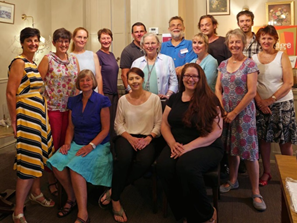
And so we leafleted, got into the local rag, on to BBC Radio Shropshire, into pub newsletters, told the college, popped into the library and all the local businesses.  We put on more demo meetings.  Meetup didn’t work – just because no-one seems to use it in Ludlow. We used Social media aggressively since we began but I think our target member didn’t spend all day on Facebook or Twitter, alas.   Our website has worked well, helping the rare people who do want help to hone their confidence and or public speaking skills to find us.

And so through patience, diligence and allowing the slow-grow to happen we chartered this month (March 2019) a healthy club with layers of advanced, middle range and new speakers which supports our mentoring program beautifully.

My takeaway from this experience?  Don’t be afraid of the small rural town (Ludlow has a population of roughly 10,000) it can still bear fruit if you are willing to be committed to the whole journey and you are persistent.  District 91 has a lot of rural areas that are hitherto untapped – they are just ripe for a Toastmasters Club, don’t you think?

I’ve been looking at where I’m going to start my next club.  It’s probably going to be in the countryside…… wish me luck!

How to deal with those pre-talk jitters

By Bret Freeman, Area J21 Director

Sweaty hands, shortness of breath, heart beating right out of chest and I felt like I was going to throw up!  That’s how it use to be every time I would stand centre stage with a live TV camera in my face and the producers voice in my ear piece saying 10 seconds to live…. 9… 8…7…6…5…4…3… 2…aaaand cue Bret….”

The voice in my head ( not the one in my ear that belonged to the producer, the other one, the one that I just can’t seem to get rid of) kept saying over and over again, “don’t screw up, don’t screw up…don’t screw up! This is live TV, don’t screw up, everyone is watching you, don’t screw up…”  and guess what… lots of times, I screwed up!  On LIVE television and in front of thousands of attending fans at MAJOR sporting events.

My light bulb moment came when I realised, I was thinking about this in the wrong way.  There were a couple of things going here. 

First of all, none of our experiences have meaning until we assign them meaning.  What I mean by that is that when we have an experience, any experience, we decide how we will react to that experience.  And, our reaction often comes out in our physiology.  If we work this backwards and I say to you, “Imaging your hands are clammy, your heart is beating fast, you have butterflies in your stomach” what emotion are you feeling?  Did you say nervousness or anxiety?  Most people do.  Wouldn’t you have the very same feelings of you hadn’t seen your partner in several weeks and were waiting for them to get off an airplane?  Or what about when you were a child waiting for Father Christmas?  You see, we assign meaning to our experiences.  Nervousness or excitement, it’s up to you.

Second, by thinking to myself, “don’t screw up… I was actually willing myself to do exactly that.  Psychology calls this the Ironic process theory.  Whatever we try NOT to think of becomes the very thing we cannot seem to get out of our heads.  Put another way, we magnify that on which we focus, and trying NOT to think of screwing up (by telling myself over and over again “Don’t screw up”) had exactly the opposite effect.  It’s like the old saying, “Don’t thing of a blue elephant”… what are you thinking of?  Can you see his blue trunk and his blue ears?… See, that’s how it works, whatever we try NOT to think of becomes the very thing that we do think of.

Once I understood this concept, it hit me like a ton of bricks, I was focusing on the wrong things!  In fact, the very definition of anxiety is focusing on what you DON’T want to happen, and whenever it was time to go to work, I was filled with anxiety.  My “Don’t screw up” became “this is going to be really hard” which ultimately became “this is impossible” and in much of my early TV work, you can see it written all over my face.  The stress and anxiety I was creating within my own head would often take over and show itself to the whole world.  I loved my job and hated my job all in the same breath.  The buzz and adrenaline from the crowds was great, but the pressure that I put on myself was terrible, and the stage fright was almost debilitating. 

Focusing on what I didn’t want to happen has given me no shortage of bloopers and poor performances early in my career, but when I changed my mindset, it made all the difference!  It is very much like when a championship skier is speeding down an advanced run, trees and obstacles everywhere, are they looking at the trees or are they looking at their line?  When a race car driver is speeding around a track, is it the walls or their line that they focus on?  When an Olympic marksman is preparing to shoot are they focusing on the target or the audience?  For me, it became so clear, when I was getting ready to deliver anything, a talk, a workshop, a live piece to a television camera, I was focused on the trees…the walls, the “screwing up” of the thing… as soon as I started focusing on my line, the voice in my head changed from “don’t screw up” to “I’m gonna smash this talk”  and it has made all the difference!  I work with lots of speakers these days and many face the very same mindset.  Corporate presentations, wedding speeches, even West End actors.  That voice inside does it’s best to get them focused on what they DON’T want to happen…and BOOM!  There it is; the stage fright, the nerves, the lack of confidence.

One of the techniques I use to help people to get over this pre-talk anxiety is the 5,4,3,2,1 method.  The next time you are getting ready to speak, before you take the stage, just take a few seconds and do the following:

Take a deep breath, breath in for the count of five and out for the count of seven.  As you are breathing in and out, look around you and locate

-5 things you can see

-4 things you can touch

-3 things you can hear

-2 things you can smell

-1 emotion you can feel (or a time you were excited)

If you follow this process before you give your next talk, it will calm your nerves, it help you to be grounded, it will help you to stop looking at the trees, and help you to find your line!

So, the next time you get ready to give a talk… find your line, focus on your line and you’ll be perfect!!

Opportunities for Everyone

By Bindu Cardoza, Area J10 Director

It’s not easy standing in front of an audience. There may be reasons for feeling scared. The crowd maybe hostile. Plenty of images can swirl through your mind. The dizziness kicks in. Nausea envelops your body. Your breath is heavy. Weights are pulling at your feet. You know you have one chance, one opportunity, one go. You step forward into the light. You take a deep breath in. You smile. You begin.

Public speaking is not easy. It takes a lot of guts to stand up in front of an audience. There are numerous ways to help you, to educate you, to make you believe that you can do it. But if you don’t have belief in yourself, then there’s no point. Being authentic is the key to success.

Toastmasters International is a phenomenon. Becoming a member is easy. Accepting the advice is another story. You see, we all want to be famous. We all want to hear the applause. However, no-one wants to be evaluated. It takes a special type of person to accept that they can improve on the advice of others. Others who are also developing their skills. Guests. Toastmasters. Friends.

My personal view of a Toastmasters meeting is that egos should be left at the door. Anyone entering the room, whether they are a member or a guest, should be treated with dignity. Every nationality, every gender, every ability, should be made welcome. Guests below the age of 18 should be able to attend so that they can see for themselves what is going on. The decision to join should never be forced.

Bindu Cardoza

Once you become a Toastmaster, the sky’s the limit.

Learning from each other. Evolving into a better speaker. Growing into a respected leader. Making friends with people who are all enthusiastic to learn. Forging alliances with likeminded people on a global scale.

Toastmasters International gives you the opportunity to find your true self, to expand on what you already know, to open your eyes to the power of communication, to become the leader you are destined to be. It’s an incredible feeling to be empowered, to have self-belief, to have encouragement from others.

Toastmasters should also adhere to the values of the organisation. Integrity. Respect. Service. Excellence. You do not remain with an organisation if you do not believe in their values. Toastmasters International is non-profit, there’s no salary to receive, there’s no financial gain. However, what you do receive is the confidence to be whatever you want to be.

It’s that simple.

You really do get out of Toastmasters International what you put into Toastmasters International.

Enjoying what you do is the key to happiness.

Making friends with people who are all keen to improve their communication and leadership skills is uplifting. Listening to each other’s opinions on best practice within Toastmaster meetings is enlightening. The skills developed can then be taken into all areas of your life. You see, if you strip away the politics, the religions, the egos, then the value of being a Toastmaster is immense and lifechanging.

What are you waiting for? Visit a Toastmasters Club today. Opportunities await.

Great Team Work

By Helena Brewer, Division J Director

Great Team Work in Division J

Stepping up to take on a leadership role is something we all can benefit from. From the elections in May 2018, the work began. 

The year began with District Officer Training in June and July. This is where I met the members of my team of six Area Directors. Division J stretches from the Thames Valley to the rolling hills of South Wales, so it wasn’t surprising that we he’d not all met before.

The role of Division Director is pivotal, sitting between the District Leadership Team and the Area Directors.  In the early days, there were messages from the District Leadership Team to pass on to the Area Directors. I found myself checking, mainly for the wording and jargon, adding useful links on the resources required and translating experienced Toastmaster speak into newbie speak. It proved to be both a challenge and a knowledge sharing exercise, dealing with questions and queries from Area Directors on what things actually meant.

With six Area Directors, I asked each of them what else they would like to take to support the Division activity. Instantly they volunteered for additional responsibilities; stepping up to organise the Division Contests, the Toastmasters Leadership Institute, providing insight and information to District reports and training, delivering workshops and promotional activity on social media.

Within a matter of weeks, everything had settled down, with the Division targets and goals for the year ahead set. The Area Directors jumped straight into their roles, arranging Club Officer Training, agreeing dates for autumn contests and looking at educational workshops for the year ahead. The support and the respect each showed the other, established a trust that my team members would support each other. By September, with the Club Officer Training under their belts, it was on to club visit reports and contest season. 

Jumping forward to March, we are now over the halfway point of this Toastmasters year.  The second round of Club Officer Training and the Division’s first Toastmasters Leadership Institute has been delivered. The Area contests are complete and now it’s on to the Division Contests and workshops in Worcester on 7 April, https://www.eventbrite.com/e/district-91-division-j-international-speech-evaluation-contest-tickets-57096337683?fbclid=IwAR0BNqEoKpxF1AkmksTiAaIjpnu6fI2Qlz7g3egs1ffn7NnobwRdovmJtyY.  

As a team we do not get to meet face to face, all together very often. We have taken full advantage of the training and executive committee meetings to catch up as a team. The way we communicated as a group became important. There are many different support tools out there for quick messaging that have proved invaluable for regular contact with each other. It’s also allowed for the relationships between the team to develop. Sometimes it’s simply a witty retort from one of the team that makes you smile. One to one catch up phone calls have provided the opportunity to share candidly and express the good and any concerns. What began with war and peace emails from me in the beginning is now reduced to my Area Directors answering each other’s questions as they arise. 

When I mentioned to the team our Division was taking over the newsletter, the articles flowed in. A bounty of riches for the District PR Manager. As with everything in Toastmasters, it’s an opportunity to try something new in a safe environment.  

We’re not sitting back just yet, there’s plenty of work supporting our members to keep us busy in the coming months. The educational awards are flooding in from members in Division J in both the legacy and the Pathways programs, with DTMs, triple crowns and Pathways Level ones in most clubs. To all members, and especially those in Division J, keep up the hard work!

Youth Leadership

By John Christie, Voice of Wales Club

Youth Leadership is a program that allows toastmasters to work in the community to inspire and equip young people to learn and succeed through effective communication and leadership.

The program is tried and trusted in schools and youth organisations since the 1960s. Stunning improvements are evident in the students after only a couple of weeks. I didn’t know that the program existed but I’m very pleased that I do now. I was mentored by Andrew Bennet who was very helpful.

It is an eight-week program of two-hour sessions from Year Ten upward and it’s based on Toastmasters meetings.

Jean Gamester with John Christie

All the elements of Toastmaster’s meetings of prepared speeches, impromptu speaking (Table Topics) and leadership are all covered excellently. The students also carried out evaluations of the Table Topics and prepared speeches.

I was lucky enough to receive a lead to Westbourne School in Penarth and worked with their staff to present the program. Kim Boland from Voice of Wales Toastmasters Club also helped. Justin, a teacher, was also involved in presenting the program. However once the program had started, the students themselves led and organised the meetings.

We were able to give eight out of thirteen students leadership roles. We provided (on loan) regalia for the President, a gavel for the Sergeant at Arms and Timing Lights for the Vice President.

The whole group elected a President, a Vice President, a Secretary and a Sergeant at Arms for the first four meetings and then elected four others for the last four meetings and they organised the meetings together with the rest of the group. Jason, Kim and I alternated in giving short educationals at each meeting.

One element in the program which is encouraged and is not often used in ordinary Toastmasters meetings is to have debates. This went down very well with the students in the school. Subjects covered were ‘Should the Death Penalty be Reinstated in the UK’ and ‘Animal Experiments are Necessary’.

Half the group were boys and half the group were girls and because this was a pre‑International Baccalaureate Year Eleven Group, none of the students had English as a first language. There were Turkish, French, German, Russian and Chinese students and a whole host of other nationalities in the group.

The program was extremely cost-effective for the school and had the benefit of having external volunteers in to help to deliver the program.

On the ninth week just before Christmas, we had what Toastmasters call the Banquet Meeting which was the Showcase to show the students new skills to teachers, pupils in other year groups, parents and other invited guests.  There was food and drink supplied by the school and we had an extremely entertaining meeting, completely organised by the students.

I really enjoyed the opportunity to take Toastmasters out into the community to showcase what Toastmasters can do in terms of communication and leadership.

I would like to thank Virginie Gautran and Justin Pocknell from the School and Kim Boland from Voice of Wales Toastmasters who helped me to deliver the program. Ann Boland introduced me to the School.

Massive thanks also to Jean Gamester, Past District Director for District 91 (UK South) and to Tony Bennett Past President of Porthcawl Speakers Club who attended the Banquet meeting.

The Toastmasters manuals for the presenters and for the students are excellent and the Youth Leadership program is now also part of the new Pathways educational program.

I do urge you to take Toastmasters out into the community in this way. It’s hugely beneficial to schools and other groups involved and to the Toastmasters volunteers from the local club.