Club Support and Membership

It is hard to believe, we only have 2 months left in the Toastmasters program year, and yet still so much we can and will achieve!

Membership

We barely concluded Talk Up Toastmasters (results still pending HQ formal notification) that we need to think about Beat the Clock starting on 1stMay! 
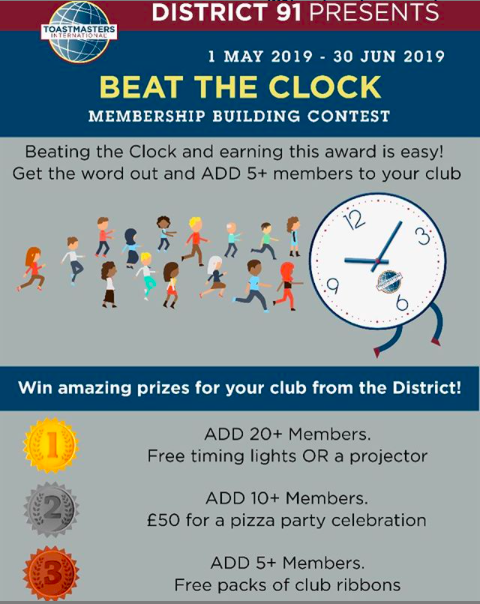
Beat The Clock


Wouldn’t this be an opportunity for an Open House?

Share the immense value we gain though membership, bring a friend or colleague to your Club meeting, we have so much to offer our communities and corporate partners! 

And if you haven’t seen a member for some time, reach out, they may just be waiting your call to come back and renew their membership!

Cannes Festival approaching – it’s Award season!

I look forward to seeing many of you at the Ashford conferencewhere I will be presenting many Awards:

  • Pioneers Award recognising our new Clubs
  • Phoenix Award recognising Clubs that have regained charter strength from low membership
  • Athena Award recognising members who went beyond the call of duty and sponsor 5+ members
  • And more … 

The Hall of Fame promises to be a fantastic event and I would love to see you all to celebrate our amazing achievements.

I am aware many members have been involved in one of our outreach programs (Speechcraft or Youth Leadership Program) and I intend to formally recognise all these contributions once we conclude the program year on 30thJune. If you have been involved or planning such outreach, get in touch. 

Club Support

We have a multitude of new Club leads at various stages, and I am actively looking for sponsors/mentors willing to support a new Club break ground and thrive. If you are a trailblazer, get in touch! Mentors need to be able to commit to 6 months supporting a new Club from Charter. 

The reward is immense, and a successful applicant will also receive Club Building credit towards the Advanced Leader Silver on the Traditional Program. 

Fancy a different challenge? Becoming a Club Coach may just be the right opportunity. Clubs at or below 12 members qualify for a Coach. Successful Coaches will transform a Club with low membership back to charter strength and for a limited period also gain both Club Building credit andDistrict Officer credit (until 30 Jun 2020 only). This is a fantastic opportunity to make a difference and gain valuable skills. Interested? Get in touch!

See you in Ashford!
Keep up the Momentum

We are slowly heading into the final two months of the Toastmasters year. These often tend to be the best months of the year for clubs as all the work invested earlier in the year is paying off. Crucially this also means that conserving momentum to start the new year on a high is crucial too.

Here’s what you can do now to end the year strongly and build-up the future at the same time:

  • Organise a special event like an open-house meeting, speakathaon or even a club social to build-up the community aspects of your club. Get people that will be on the committee next year to help with these!
  • Launch a social media campaign, use #MyWhy video testimonials from members to generate interest from potential guests and inspire them with the stories of your newly joined members. 
  • Organise an award evening to recognise all the members who have achieved educational awards this year and those who will do so soon.
  • Start the organisation, at least on a basic level, of meetings taking place from 1stJuly. Do not leave a clean slate for the next club leaders to start on from, leave them something they can built on instead! Continuity breeds success!
  • Create a file with all social media, email and website passwords for the next club leadership team to use. Similarly, begin the process of updating bank account signatories now as this can take a while.

The New and the Old

DIVISION CONFERENCES

This month has seen all the Division Conferences, including the Division finals of the International Speech and Evaluation Contests. Congratulations to all the contestants for the high standard of speeches and evaluations. There has been good representation from the District Leadership Team at each event, and I was delighted to be able to attend the Division K and Division B contests, both held at The University of Law, which was an excellent venue. Both days were packed with fantastic workshops and superbly organised. I know all of the Division events were similarly excellent. Thanks to all the Division Directors and the many others who supported them.

DISTRICT CONFERENCE

Now the contest winners go on to the District Finals in Ashford from 3rdto 5thMay! It is going to be a truly amazing weekend – the first District 91 conference to span three days, and to include all four contests – Table Topics; Evaluation; Humorous and the International Speech final. Add to those, ten wonderful workshops, two captivating keynote speeches, and the dramatic District Council meeting and you have an occasion not to be missed! Have a look at the full programme and book your tickets here: 

The Agenda for the District Council Meeting is also available here: 

THE NEW AND THE OLD

I have also had the opportunity this month to attend the first formal meeting of one of our newest clubs, The Workshop Speakers in London. Thanks to Club President, Lili Bai, and all the members for their warm welcome, and a great meeting! By contrast, one of my own clubs, County Communicators, is celebrating its 10thbirthday and as a proud Founder Member I will be looking back at its conception and reflecting on its remarkable success.

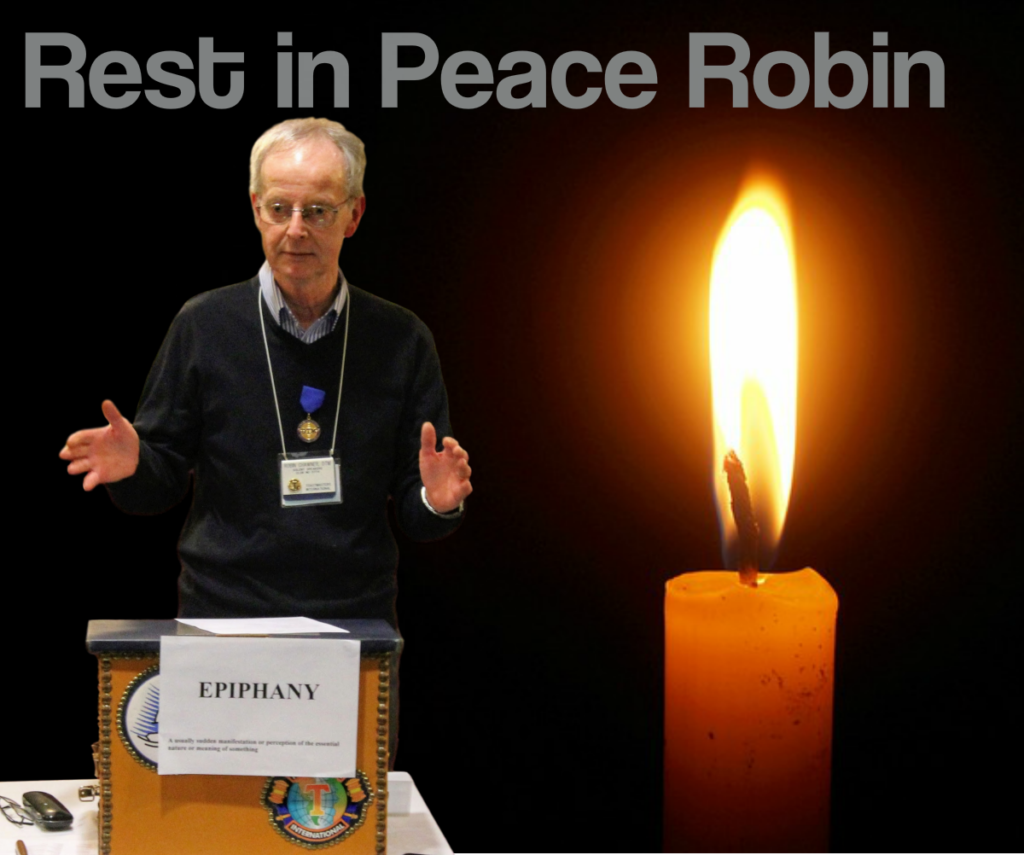
ROBIN CHAWNER DTM

Robin Chawner

On a sad note, another Founder Member of County Communicators, Solent Speakers and my home club, Arun Speakers, Robin Chawner, passed away on 11 April 2019.  He introduced the 3-2-1 method of evaluation and an exemplary Toastmaster, Robin was involved in helping to start no less than eight clubs that I know of. He was always so generous in his support to every member and will be sorely missed by so many people. I know that Robin was very proud that I am the first member of Arun Speakers to be District Director, and I hope I have lived up to his high standards.

Yukitaka Matsuda – Candidate for Division Director

Yukitaka Matsuda – Candidate for Division Director

Why are you running for this District Leadership Role? Why now?

What is your vision for the role?

How will you go about achieving this vision?

How do you plan to achieve Distinguished status?

What is the greatest challenge you may face as District Leader?


How will you work with others to achieve success?


How to Avoid the Last minute Panic…

By Andy Hessey, Area J4 Director

How many people have signed up for a speech with the words “I’ve got plenty of time” in their heads, only to wake up one morning with drenched in a cold sweat and with  clammy palms followed by the horrible realisation that you are hours away from that delivering a speech to a sea of expectant faces when all you have is a rough outline of your project that you created down at the pub 2 weeks ago after ½  bottle of gin and 5 Tequila Slammers?

Andy Hessey

We’ve all been there and we all know how gut wrenching it is.  Panic sets in, followed by the crushing disappointment that it’s not going to be as good as you had thought it was going to be due to the fact you’ve not had chance to give it the finesse and polishing that turns an average speech into one that can win a contest.

So why are we so bad at planning ahead?  Is it because as Toastmasters we live in the present with our speeches or is it that we just don’t give enough importance to planning them, just assuming that it will be alright on the night?  To be fair, for most Toastmasters, a speech is just another ball to juggle along with family, work and friends etc – but that’s not really a good excuse. 

With my Project had on, I know that with just a little forward thinking, the stress really can be taken out of your prep work, so, allow me, if I may, to share my top 3 tips for planning ahead to make sure that it’s not another last-minute.com speech.

  • Think bigger than the next speech

If you are only planning one speech at a time then you’re not going to get the most leverage out of your time.  I’m not saying that you should plan your entire path to your DTM (I’m not stopping you) but planning multiple speeches is the way to go.  You don’t have to get your entire pathway booked in on EasySpeak from Icebreaker to final project but think about how quickly you want to get, let’s say, from Level 2 to Level 3 by setting that as a goal with marker points along the way.

Having 4 or 5 speeches, planned in your calendar gives you much better visibility of your deadlines.  It allows you to think ahead as to where you’re going to long days at work, or maybe a week’s holiday and try to avoid busy work times – you really don’t need the stress of both! 

Finally, If possible try to sit down with your VPE and try to schedule your speeches on a regular cycle (every 6 – 8 weeks or so) so that you can manage your own expectations.

  • That “My Little Pony” notebook can be a saviour

Always keep a notebook with you to jot down ideas.  Inspiration can hit us at the strangest of times (although if it hits you while crossing the road, chances are it’s not inspiration .. it’s more likely a car).

I have a notebook full of ideas for speeches.  Some are roughly formed, others are no more than vague ideas or catchy titles.  Some of these ideas will eventually become icebreakers or contest speeches, others will never make it in front of an audience but that doesn’t matter.  Sometimes speeches can develop months or years after they were first mooted 

Having a book full of part developed speeches and ideas might, at first glance, not seem terribly useful, but it can also be a great psychological safety net.  Having proof that you can generate ideas helps to negate the excuse of “I’ve got no ideas for a speech”. 

  • Cookie Cut it!

In Project Management, the term “Cookie Cutter” refers to a repeatable, reusable process to deliver the same high quality product time and again.  It’s a great tool that can be used in many circumstances – and speech preparation is one of them.

Creating a cookie cutter is easy – Break down what steps you need to take in order to be ready and write them down.  Work out how long you need to feel comfortable with each bit.  For example, you might only want to spend ½ hour writing your speech, but will want to practice it 10 – 15 times all the way through, which is in total about 2 ½ hours to get a speech ready.    This can then be split across a week, 2 weeks … however long you feel you need to be relaxed with the content and delivery.

Once you have your template in place, make sure you stick to it!  Yes, of course, it can be tweaked and for big speeches such as a contest, you might need a bit longer, but once you are happy with your cookie cutter, don’t try to make too many changes!

            Planning time for a speech is one of the best ways of calming nerves and providing clarity and focus.  Just remember the next time you put yourself forward for a speech, it doesn’t have to come out of thin air like a massive thunderclap… It can all be there ahead of those critical minutes in front of your audience