
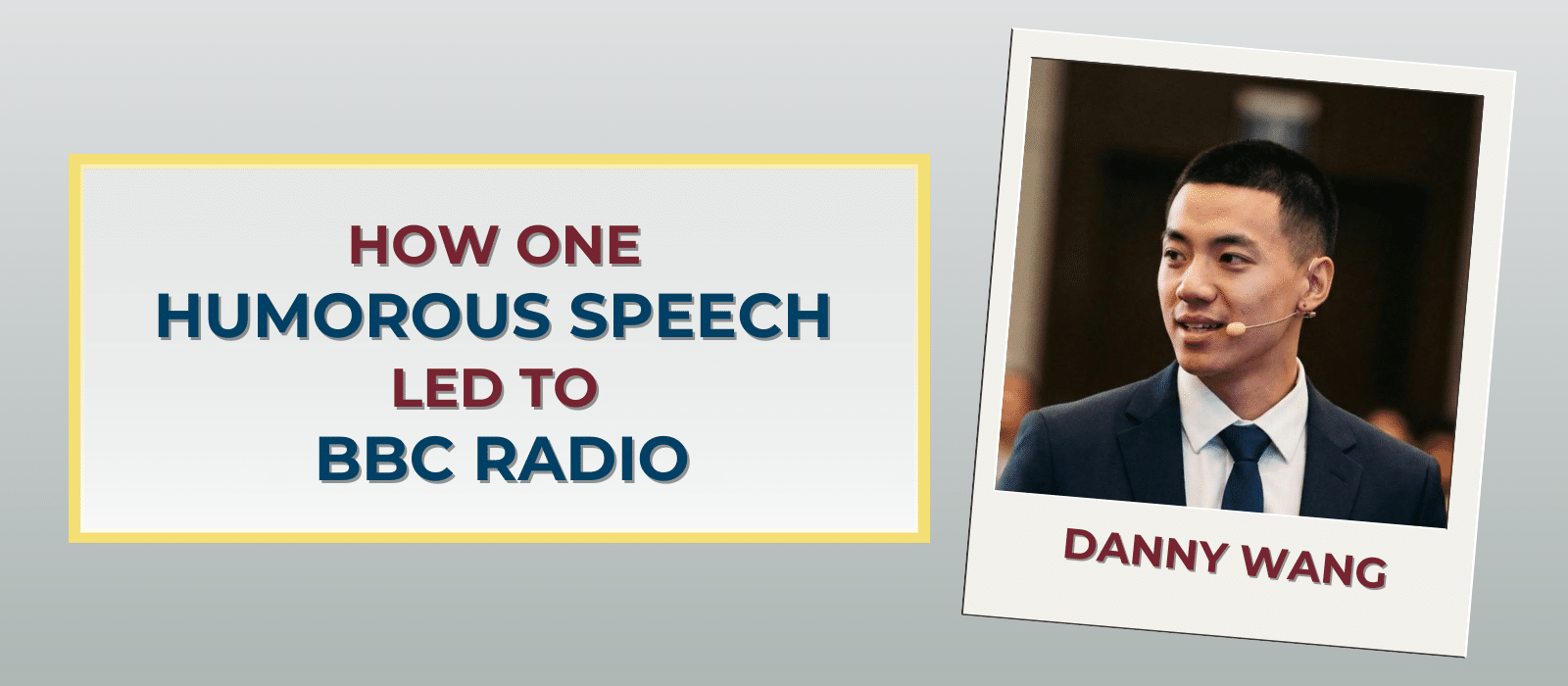
Danny Wang, our District Humorous Speech Champion, recently took his speaking journey beyond the Toastmasters stage and onto BBC Radio Berkshire. We asked Danny about his contest speech, the unexpected radio call, and what other clubs can learn from sharing real human stories with local media.
What was your humorous speech about, and why do you think it connected with the audience?
Honestly, the whole speech was just me exposing my own chaos. I basically talked about something stupid I did, exaggerated it slightly (but also… not really), and people related because everyone’s life is a bit of a mess. The audience laughed because they saw themselves in it – or at least saw someone doing worse than them, which is always comforting. We’ve all been through a ‘frugal’ phase or something somewhat obsessed. I think the Donald Trump impression was the cherry on top though.
How did the BBC Radio opportunity come about?
I got into work one morning, and as I was making my coffee I got a call from an unknown number. I picked up, and it was BBC Radio Berkshire! It went along the lines of ‘hey, ya wanna speak on the radio in a sec’ and I was like, ‘hell yeah’. They were doing a bit about public speaking, and crushing fears – I guess they had found my club or seen my newspaper article.
Was speaking on radio different from speaking at Toastmasters?
Yeah, massively. In Toastmasters you can see people’s faces. On radio, you’re basically just talking on the phone. Kind of felt like speaking to senior management. Also, no clapping. Very rude.
What was the reaction from people around you after the radio appearance?
I pre-warned my colleagues and mum I’d be on the radio. They all listened in sneakily and sent some wholesome messages after. It was funny because I actually went to a meeting room in the office and my colleagues were watching me whilst listening to it – if that makes sense?
Why should clubs consider approaching local radio stations with their stories?
Because radio stations are desperate for local stories that aren’t about potholes or lost cats. Toastmasters can have a goldmine of vocational, weird, wholesome, human stories. They want that stuff.
What kind of stories do you think radio stations would be interested in?
Anything that’s: personal, slightly funny, slightly chaotic or involves someone overcoming something. If it sounds like something your friend would tell you in the pub, I reckon they’d love it.
What advice would you give to clubs approaching local media?
I did not approach them myself, so I’m not sure what the perfect approach would be. I’d say don’t send them a 500-word essay. Don’t be formal. Don’t say “we would like to enquire about media opportunities”. Just talk like a human. And don’t pitch “we meet every second Tuesday” – pitch an actual story. Local if possible!
What did this experience show you about Toastmasters beyond the club room?
That nobody outside Toastmasters knows what we do… but once they hear about it, they’re weirdly interested. People love self-improvement stories, especially when they’re not preachy.
What is next for you?
God, there’s so many things. Few big goals of mine are to get onto the international stage, actually make work on my startup, climb a couple mountains, do well at work – the usual, ya know? Then after that, some sleep. Haven’t been getting enough of that recently. Then maybe more speaking, more comedy, maybe another contest, maybe something completely random. I’m just saying yes to things and seeing what happens.

Danny’s story is a reminder that clubs do not always need a “perfect” story to approach local media. Sometimes the best stories are personal, funny, chaotic, local, and human.
Last Updated on 26th May 2026 by Allen Paul